
Case Study · AI Procedure Extraction & Skill Alignment

Near-Miss Prevention Pipeline

A 3-stage pipeline that turns raw energy field procedures into structured tasks, role-verified skills, and safety curricula, replacing a single-prompt vendor tool that could not hold the job without breaking down.

Procedure Extraction Skill Alignment Near-Miss Reduction Snowflake + Airtable

Portfolio excerpt; operational details redacted.

Executive Summary

AI can't do it all in one prompt. Splitting the problem into single-purpose stages turned an inconsistent prototype into a system a global energy operator now runs overnight.

The problem

  • A previous vendor tried to extract tasks, required skills, and training criteria in a single prompt. The context window overloaded and the output was inconsistent and unusable.
  • Subject Matter Experts, at a high hourly cost, were manually reading and parsing Standard Operating Procedures. They completed 10 to 12 documents a week.
  • Field tasks, role descriptions, and safety protocols, like role-specific PPE requirements across plant operators and field engineers, drifted out of alignment, leaving skill gaps that raised near-miss risk.
The solution

  • Re-architected the single overloaded prompt into a 3-stage, single-responsibility pipeline: task extraction, skill mapping, knowledge criteria. Each stage does one job and does it deterministically.
  • Built an Airtable relational hub that pulls role data from Snowflake, maps procedures to exact job descriptions, and pushes verified criteria back to Snowflake and the enterprise Learning Center.
  • Added a double-weighted confidence scoring model so SMEs review only the low-confidence edge cases instead of reading every compliant procedure by hand.
  • Modular AI Prompts
  • Airtable Relational Hub
  • Snowflake Sync
  • Confidence Scoring
  • Skill Gap Analytics

Context & Objectives

One tool, one enterprise, and a two-year backlog of unread procedures.

Operational context

  • 1,200+ SOPs across existing and newly acquired business units, in inconsistent formats.
  • SMEs bottlenecked reading procedures line by line instead of doing higher-value field engineering work.
  • Role-specific safety requirements, PPE and hazardous material protocols, buried inside procedure text, not connected to any system of record for job roles.
  • No mechanism to catch a mismatch between what a procedure required and what a role was actually trained or equipped for, until a near-miss surfaced it.

Objectives

  • Extract and standardize tasks from raw SOPs without human transcription.
  • Verify every task against the actual job description for the role performing it.
  • Generate the safety and knowledge criteria L&D needs to close gaps before they cause incidents.
  • Build something the internal team can run and extend themselves, including during M&A integrations.

The Pipeline

Three single-job stages, not one prompt trying to do everything.

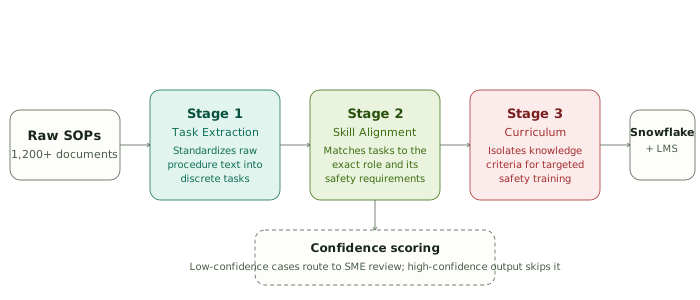
Stage 1 · Task Extraction

Extracts and standardizes discrete operational tasks from raw SOP text, producing consistent output whether the source procedure came from the core business or a newly acquired unit.

Stage 2 · Skill & Role Alignment

Matches each extracted task against the exact job description in Snowflake, verifying that field tasks match the competencies and safety protocols required for that role, plant operator, technician, or engineer.

Stage 3 · Knowledge Criteria & Curriculum

Isolates the foundational knowledge behind each verified skill, so L&D can generate targeted safety and training curricula the same day a procedure is ingested.

Raw SOPs feed a three-stage pipeline. Stage 1 extracts standardized tasks. Stage 2 aligns each task to the exact job role and its safety requirements in Snowflake. Stage 3 generates knowledge criteria and curricula. Verified output syncs back to Snowflake and the enterprise Learning Center, with low-confidence extractions routed to an SME review queue instead of blocking the run.
Raw SOPs to synced, verified curricula in three deterministic stages.

Integration & Governance

The data layer that makes the pipeline trustworthy, not just fast.

Central data pipeline

Airtable acts as the relational middle layer: it ingests job roles from Snowflake, runs the extraction and alignment logic, and pushes validated findings back to Snowflake and the enterprise Learning Center.

Confidence scoring

Every extraction gets two independent accuracy weights. High-confidence output skips human review entirely. Low-confidence edge cases route straight to an SME review queue, so review time goes to the cases that actually need it.

Day 1 gap detection

Missing skill or safety criteria surface the moment a procedure is ingested, so management can apply mitigation rules immediately instead of finding the gap after an incident.

Impact

Two years of backlog became an overnight run, and SMEs stopped being manual readers.

Processing velocity

  • 10 to 12 procedures a week, manually, became 1,200+ procedures overnight.
  • A roughly 100 to 120 week batch, about two years, now completes in a day.

Cost and labor reallocation

  • An estimated $300,000 to $400,000+ in SME labor per batch dropped by more than 80%.
  • Roughly 4,000 SME hours were freed per 1,200 procedures, redirected to field engineering instead of document parsing.

Safety and near-miss reduction

Field tasks are now standardized against exact job descriptions, closing the PPE and hazardous-material gaps that were the actual source of near-miss risk.

Built for scale

Foreign SOPs from newly acquired business units get ingested and aligned to standard company taxonomies overnight, with no manual re-mapping.

Backlog
2 yrs → overnight
SME cost
-80%+ per batch
SME hours freed
~4,000 / 1,200 SOPs

Handoff & Ownership

The client owns this now, not me.

Context engineering education

  • Internal technical leads were taught how LLM context windows actually work, and why single-responsibility prompts eliminate the hallucination and drift that broke the original vendor tool.

Self-managed exception logic

  • The internal team can adjust confidence thresholds and build new human-in-the-loop routing rules directly in Airtable, with no developer support required.
I deliver the system. You keep the ownership.

What This Unlocks Next

A repeatable framework for every future acquisition, not a one-time project.

With procedures, roles, and safety criteria now aligned in one governed system, the enterprise has a repeatable framework for every future acquisition: ingest the incoming SOPs, run the same three stages, and know within a day where the new business unit's field teams have safety or skill gaps, instead of finding out after a near-miss.

↑ Back to top